

Did man really walk
on the Moon ???

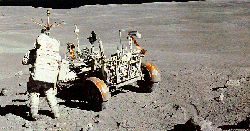
Did man really walk on the
Moon or was it the ultimate camera trick, asks David Milne? The greater lunar
lie. Feet In the early hours of May 16, 1990, after a week spent watching old
video footage of man on the Moon, a thought was turning into an obsession in
the mind of Ralph Rene.
“How can the flag be fluttering,” the 47 year
old American kept asking himself, “when there’s no wind on the atmosphere free
Moon?” That moment was to be the beginning of an incredible Space odyssey for
the self-taught engineer from New Jersey. He started investigating the Apollo
Moon landings, scouring every NASA film, photo and report with a growing sense
of wonder, until finally reaching an awesome conclusion: America had never put
a man on the Moon. The giant leap for mankind was fake.
It is of course the conspiracy theory to end
all conspiracy theories. But Rene has now put all his findings into a startling
book entitled NASA Mooned America. Published
by himself, it’s being sold by mail order – and is a compelling read.
The story lifts off in 1961 with Russia
firing Yuri Gagarin into space, leaving a panicked America trailing in the
space race.
At an emergency meeting of Congress,
President Kennedy proposed the ultimate face saver, put a man on the Moon. With
an impassioned speech he secured the plan an unbelievable 40 billion dollars.
And so, says Rene (and a growing number of astro-physicists are beginning to
agree with him), the great Moon hoax was born.
Between 1969 and 1972, seven Apollo ships
headed to the Moon. Six claim to have made it, with the ill fated Apollo
13–whose oxygen tanks apparently exploded halfway–being the only casualties.
But with the exception of the known rocks,
which could have been easily mocked up in a lab, the photographs and film
footage are the only proof that the Eagle ever landed. And Rene believes
they’re fake. For a start, he says, the TV footage was hopeless. The world
tuned in to watch what looked like two blurred white ghosts gambol threw rocks
and dust. Part of the reason for the low quality was that, strangely, NASA
provided no direct link up. So networks actually had to film “man’s greatest
achievement” from a TV screen in Houston–a deliberate ploy, says Rene, so that
nobody could properly examine it.
By contrast, the still photos were stunning.
Yet that’s just the problem. The astronauts took thousands of pictures, each
one perfectly exposed and sharply focused. Not one was badly composed or even
blurred. As Rene points out, that’s not all:
§
The cameras had no white meters or view
finders. So the astronauts achieved this feat without being able to see what
they were doing.
§
Their film stock was unaffected by the
intense peaks and powerful cosmic radiation on the Moon, conditions that should
have made it useless.
§
They managed to adjust their cameras, change
film and swap filters in pressurized clubs. It should have been almost
impossible to bend their fingers. .
Award winning British photographer David
Persey is convinced the pictures are fake. His astonishing findings are
explained alongside the pictures on these pages, but the basic points are as
follows:
§
The shadows could only have been created with
multiple light sources and, in particular, powerful spotlights. But the only
light source on the Moon was the sun.
§
The American flag and the words “United
States” are always brightly lit, even when everything around is in shadow.
§
Not one still picture matches the film
footage, yet NASA claims both were shot at the same time.
§
The pictures are so perfect, each one would
have taken a slick advertising agency hours to put them together. But the
astronauts managed it repeatedly.
David Persey believes the mistakes were
deliberate, left there by “whistle blowers”, who were keen for the truth to one
day get out. If Persey is right and the pictures are fake, then we’ve only
NASA’s word that man ever went to the Moon. And, asks Rene, why would anyone
fake pictures of an event that actually happened?
The questions don’t stop there. Outer space
is awash with deadly radiation that emanates from solar flares firing out from
the sun. Standard astronauts orbiting earth in near space, like those who
recently fixed the Hubble telescope, are protected by the earth’s Van Allen
belt. But the Moon is 240,000 miles distant, way outside this safe band. And,
during the Apollo flights, astronomical data shows there were no less than
1,485 such flares.
John Mauldin, a physicist who works for NASA,
once said shielding at least two meters thick would be needed. Yet the walls of
the Lunar Landers which took astronauts from the spaceship to the moons surface
were, said NASA, “about the thickness of heavy duty aluminum foil”. How could
that stop this deadly radiation? And if the astronauts were protected by their
space suits, why didn’t rescue workers use such protective gear at the
Chernobyl meltdown, which released only a fraction of the dose astronauts would
encounter? Not one Apollo astronaut ever contracted cancer–not even the Apollo
16 crew who were on their way to the Moon when a big flare started.
“They should have been fried,” says Rene.
Furthermore, every Apollo mission before number 11 (the first to the Moon) was
plagued with around 20,000 defects a-piece. Yet, with the exception of Apollo
13, NASA claims there wasn’t one major technical problem on any of their Moon
missions. Just one defect could have blown the whole thing. “The odds against
this are so unlikely that God must have been the co-pilot,” says Rene.
Several years after NASA claimed its first
Moon landing, Buzz Aldrin “the second man on the Moon”–was asked at a banquet
what it felt like to step on to the lunar surface.
Aldrin staggered to his feet and left the
room crying uncontrollably. It would not be the last time he did this. “It
strikes me he’s suffering from trying to live out a very big lie,” says Rene.
Aldrin may also fear for his life. Virgil Grissom, a NASA astronaut, was due to
pilot Apollo 1. In January 1967, he baited the Apollo program by hanging a
lemon on his Apollo capsule (in the US, unroadworthy cars are called lemons)
and told his wife Betty: “if there is ever a serious accident in the space
program, it’s likely to be me.”
Nobody knows what fuelled his fears, but by
the end of the month he and his two co-pilots were dead, burnt to death during
a test run when their capsule, pumped full of high pressure pure oxygen,
exploded. Scientists couldn’t believe NASA’s carelessness–even a chemistry
student in high school knows high pressure oxygen is extremely explosive. In
fact, before the first manned Apollo fight even cleared the launch pad, a total
of 11 would be astronauts were dead. Apart from the three who were incinerated,
seven died in plane crashes and one in a car smash. Now this is a spectacular
accident rate.
“One wonders if these ‘accidents’ weren’t
NASA’s way of correcting mistakes,” says Rene. “Of saying that some of these
men didn’t have the sort of ‘right stuff’ they were looking for.”
NASA won’t respond to any of these claims,
their press office will only say that the Moon landings happened and the
pictures are real. But a NASA public affairs officer called Julian Scheer once
delighted 200 guests at a private party with footage of astronauts apparently
on a lunar landscape. It had been made on a mission film set and was identical
to what NASA claimed was they real lunar landscape.
“The purpose of this film,” Scheer told the
enthralled group, “is to indicate that you really can fake things on the
ground, almost to the point of deception.” He then invited his audience to
“come to your own decision about whether or not man actually did walk on the
Moon”. A sudden attack of honesty? You bet, says Rene, who claims the only real
thing about the Apollo missions were the lift offs. The astronauts simply have
to be on board, he says, in case the rocket exploded. “It was the easiest way
to ensure NASA wasn’t left with three astronauts who ought to be dead,” he
claims, adding that they came down a day or so later, out of the public eye
(global surveillance wasn’t what it is now) and into the safe hands of NASA
officials, who whisked them off to prepare for the big day a week later.
And now NASA is planning another giant
step–project Outreach, a one trillion dollar manned mission to Mars. “Think
what they’ll be able to mock up with today’s computer graphics,” says Rene
chillingly. “Special effects was in its infancy in the 60′s. This time round
will have no way of determining the truth.”
Space oddities:
§
Apollo 14 astronaut Allen Shepard played golf
on the Moon. In front of a worldwide TV audience, Mission Control teased him
about slicing the ball to the right. Yet a slice is caused by uneven air flow
over the ball. The Moon has no atmosphere and no air.
§
A camera panned upwards to catch Apollo 16′s
Lunar Lander lifting off the Moon. Who did the filming?
§
One NASA picture from Apollo 11 is looking up
at Neil Armstrong about to take his giant step for mankind. The photographer
must have been lying on the planet surface. If Armstrong was the first man on
the Moon, then who took the shot?
§
The pressure inside a space suit was greater
than inside a football. The astronauts should have been puffed out like the
Michelin Man, but were seen freely bending their joints.
§
The Moon landings took place during the Cold
War. Why didn’t America make a signal on the Moon that could be seen from
Earth? The PR would have been phenomenal and it could have been easily done
with magnesium flares.
§
Text from pictures in the article show only
two men walked on the Moon during the Apollo 12 mission. Yet the astronaut
reflected in the visor has no camera. Who took the shot?
§
The flags shadow goes behind the rock so
doesn’t match the dark line in the foreground, which looks like a line cord. So
the shadow to the lower right of the spaceman must be the flag. Where is his
shadow? And why is the flag fluttering?
§
How can the flag be brightly lit when its not
facing any light ?
§
And where, in all of these shots, are the
stars?
§
The Lander weighed 17 tons yet the astronauts
feet seem to have made a bigger dent in the dust.
§
The powerful booster rocket at the base of
the Lunar Lander was fired to slow descent to the moons service. Yet it has
left no traces of blasting on the dust underneath. It should have created a
small crater, yet the booster looks like it’s never been fired…

No comments:
Post a Comment